The System That Changed Everything (And What It Got Wrong)
In the 1990s, celebrity stylist André Walker, known for his work with Oprah Winfrey, developed a hair typing system that categorised curl patterns from 1 (straight) to 4C (tightly coiled). The system was adopted widely, especially after the natural hair movement gained momentum in the 2000s and 2010s. Walk into any natural hair community online today and the first question you will be asked is: what is your hair type?
The typing system is a useful common language. But it has a fundamental problem: it describes the shape of the curl, not the behaviour of the hair. And behaviour is what determines what your hair needs.
Texture
The Type 4 family
4A
Springy coils
Tight, springy S-shaped coils with a visible curl pattern. Holds moisture best of the three.
Shrinkage ~30%
4B
Sharp Z-bends
Bends in sharp angles rather than curling. Densely packed, fluffy, less defined.
Shrinkage ~50%
4C
Tightest coil
The tightest pattern, often with no defined curl until defined. Maximum volume — and maximum shrinkage.
Shrinkage up to 75%
Shrinkage is not lost length — it is the coil doing exactly what it should. The tighter the pattern, the more it springs back. We measure length stretched, and celebrate the spring.
What the Numbers Do Not Tell You
Two women can both have 4C hair — the tightest, most densely coiled pattern — and have completely different hair care needs. One might have low porosity hair that resists moisture and requires steam treatments and lightweight oils. The other might have high porosity hair that drinks up moisture but releases it within hours, requiring heavy sealants. The same product that transforms one woman's hair will leave the other's flat, greasy, and frustrated.
The curl pattern tells you nothing about: - Porosity — how easily moisture enters and exits the hair shaft - Density — how many strands per square centimetre on the scalp - Elasticity — the hair's ability to stretch without breaking - Width — the diameter of the individual strand (fine, medium, coarse)
These four factors matter far more for product selection and routine design than the shape of the curl.
Under the microscope
A single strand, magnified
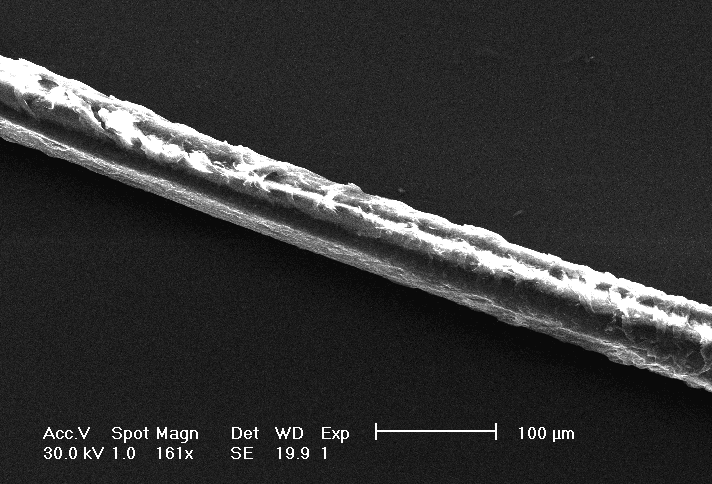
Under the electron microscope a human hair is a rope of keratin sheathed in the cuticle — the strand's outer armour. Oils and butters lie over it, slowing the moisture loss that costs you length.
SEM: Foreade · CC BY-SA 4.0 · Wikimedia Commons
Understanding Porosity
Porosity is determined by the cuticle layer — the outermost scale-like cells that cover the hair shaft. When the cuticle lies flat and smooth, moisture struggles to enter (low porosity). When the cuticle is raised and rough — from heat, chemical processing, mechanical damage, or genetics — moisture enters readily but escapes just as easily (high porosity).
Low porosity signs
Products sit on the hair rather than absorbing. Hair takes a long time to get fully wet in the shower. Hair air-dries slowly.
High porosity signs
Hair absorbs water quickly but feels dry again within hours. Hair is prone to frizz in humidity. Products seem to disappear into the hair.
For low porosity
Use lightweight oils like hemp seed oil and jojoba. Apply products to damp hair. Use heat (a plastic cap and warm towel, or a hooded dryer) to open the cuticle before deep conditioning.
For high porosity
Use heavier sealants like castor oil and shea butter. Seal moisture in immediately after washing with a thick cream or balm. Protein treatments help fill gaps in the cuticle.
Understanding Elasticity
Take a strand of your hair when it is wet. Gently stretch it. Healthy hair with good elasticity will stretch 30–50% of its length before snapping, then spring back. Hair with poor elasticity will either snap immediately (protein deficiency, brittleness) or stretch but not return to its original length (moisture overload, structural damage).
Elasticity is the balance between protein and moisture. Too little protein makes hair weak and limp. Too much protein makes it stiff and brittle. A well-formulated product line provides both — which is why our balm includes hydrolysed proteins alongside moisture-rich botanical oils.
Understanding Density
Hair density is about how many follicles you have. A woman with low-density hair may have 1,800–2,200 follicles on her scalp; high density can be 3,000+. Density affects how much product you need and how your styles look.
Low-density hair can be weighed down by heavy products, making it appear thin and flat. High-density hair handles heavier products well and benefits from them.
Texture
The Type 4 family
4A
Springy coils
Tight, springy S-shaped coils with a visible curl pattern. Holds moisture best of the three.
Shrinkage ~30%
4B
Sharp Z-bends
Bends in sharp angles rather than curling. Densely packed, fluffy, less defined.
Shrinkage ~50%
4C
Tightest coil
The tightest pattern, often with no defined curl until defined. Maximum volume — and maximum shrinkage.
Shrinkage up to 75%
Shrinkage is not lost length — it is the coil doing exactly what it should. The tighter the pattern, the more it springs back. We measure length stretched, and celebrate the spring.
A Better Way to Understand Your Hair
Instead of asking "What is my hair type?" ask:
1. When I wet my hair, does water bead up or absorb immediately? (porosity) 2. When I stretch a wet strand, does it snap or stretch? (elasticity/protein-moisture balance) 3. When I look at my scalp, can I see it clearly between strands? (density) 4. When I hold a single strand against a white background, how wide is it? (width)
Answer these questions and your product choices become logical rather than experimental. Your hair is not a mystery. It is a biological system communicating clearly. The ritual is learning to listen.