The Organ Nobody Talks About
Your scalp is skin. This sounds obvious. But most hair care conversations treat it as if it were a neutral surface that products pass through on their way to the shaft. The scalp gets conditioned as an afterthought, if at all.
This is backward. Every strand of hair emerges from a follicle embedded in the scalp. The health of the follicle — and therefore the health of the hair it produces — is entirely dependent on the health of the scalp tissue around it.
You cannot grow thriving hair from a compromised scalp. It is not possible.

The Scalp Ecosystem
The scalp supports a complex microbiome — a community of bacteria, fungi, and other microorganisms that exists in careful balance. When this balance is disrupted, inflammation follows.
The most common disruptor is *Malassezia*, a yeast-like fungus that feeds on sebum. In controlled amounts it is normal and harmless. When it overgrows — due to excess sebum, overwashing that disrupts the microbiome, or immune responses — it produces oleic acid as a byproduct. Oleic acid irritates the scalp, causing cell turnover to accelerate. The result is dandruff, seborrheic dermatitis, and in severe cases, inflammation that constricts blood flow to the follicle.
“Constricted blood flow to the follicle means nutrients and oxygen are not reaching the hair-producing cells efficiently. This leads to thinner, weaker hair emerging from the follicle — or no hair at all.”
Under the microscope
The cuticle's overlapping scales
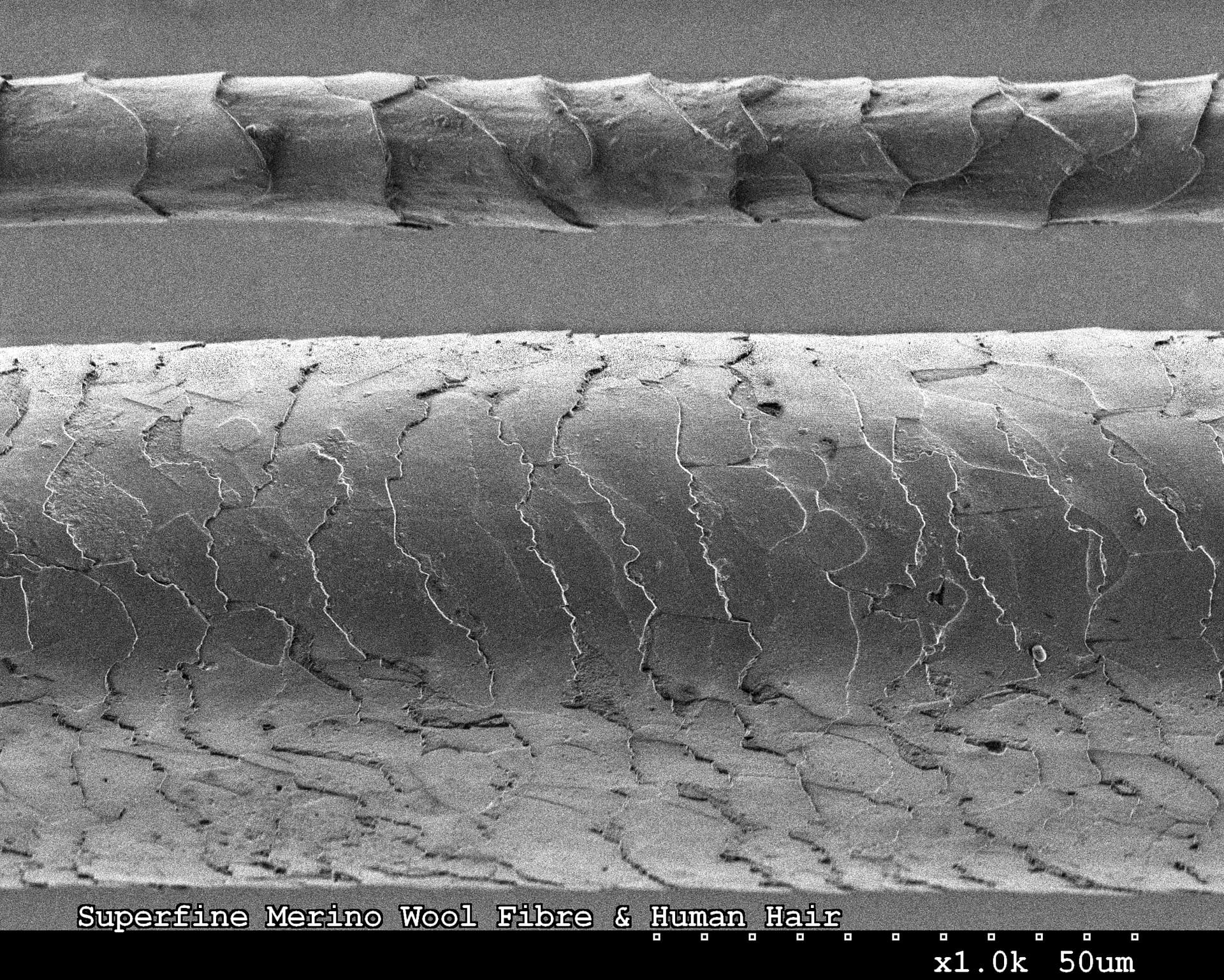
Human hair (below) shares the tiled, overlapping-scale architecture of wool (above). Sealed flat, these scales trap moisture in; lifted, they let it escape.
SEM: CSIRO · CC BY 3.0
The Role of Sebum
Sebaceous glands attached to each follicle produce sebum — the scalp's natural conditioner. Sebum is a complex mixture of triglycerides, wax esters, squalene, and free fatty acids. It travels down the hair shaft from root to tip, conditioning as it goes.
For Type 4 hair, this is where the structure of the curl becomes relevant. The tight helical pattern of the curl means sebum struggles to travel from root to tip — it gets trapped in the coils. This is why natural Type 4 hair is so often dry at the ends even when the scalp is producing adequate sebum.
The solution is not more products at the scalp. It is a consistent application of oils to the mid-lengths and ends, mimicking what sebum does naturally on straighter hair types.
Rosemary — circulation at the root.
What Compromises the Scalp
Overwashing
Shampoo is designed to strip sebum. Used too frequently, it removes the microbiome's food source and the hair's natural conditioner. For most Type 4 hair, once or twice a week is optimal. Co-washing (conditioner only, no shampoo) between shampoo sessions maintains moisture without stripping.
Product buildup
Heavy products that are not water-soluble accumulate on the scalp over time, clogging follicles and creating an environment where *Malassezia* can thrive. Use a clarifying shampoo monthly to reset.
Tight hairstyles
Constant tension on the follicle from tight braids or ponytails can cause traction alopecia — permanent hair loss along the hairline. The follicle under sustained mechanical stress will eventually cease producing hair.
Heat
High heat from flat irons and blow dryers applied too close to the scalp damages sebaceous glands and reduces their output over time.
The Oils That Feed the Scalp
Our Signature Oil was formulated specifically for scalp application. Each ingredient addresses a different aspect of scalp health:
Black Cumin (Nigella sativa)
Contains thymoquinone, which inhibits the inflammatory cascade that underlies seborrheic dermatitis and dandruff. Shown in several studies to reduce *Malassezia* overgrowth.
Neem (Azadirachta indica)
Azadirachtin and nimbin are potent antifungal and antibacterial compounds. Used for centuries in Ayurvedic and East African traditions for scalp conditions.
Rosemary
A 2023 randomised controlled trial published in JAMA Dermatology compared rosemary oil to minoxidil 2% for androgenic hair loss. After 6 months, both groups showed equivalent hair count increases. Rosemary achieved this through stimulation of blood circulation and the action of carnosic acid on nerve growth factor, which supports follicle survival.
Castor Oil
The high concentration of ricinoleic acid creates an environment in the follicle that is inhospitable to *Malassezia* and other pathogens, while its viscosity locks in moisture at the scalp surface.
Under the microscope
A single strand, magnified
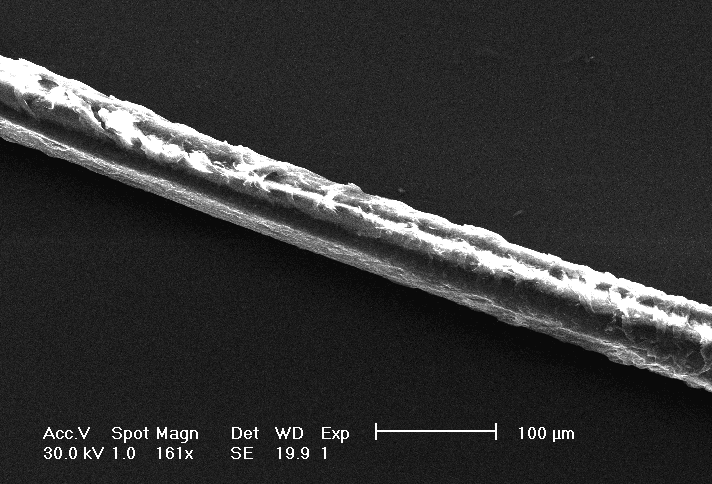
Under the electron microscope a human hair is a rope of keratin sheathed in the cuticle — the strand's outer armour. Oils and butters lie over it, slowing the moisture loss that costs you length.
SEM: Foreade · CC BY-SA 4.0 · Wikimedia Commons
The Ritual
Apply oil to a clean, slightly damp scalp. Part the hair in sections. Place the dropper or fingers directly on the scalp — not the hair. Massage in circular motions for 3–5 minutes, working from nape to crown. This massage is not incidental. It stimulates blood flow, the mechanism by which nutrients reach the follicle.
Do this 3–4 times weekly as maintenance, nightly for the first two weeks of a new routine.
Your scalp will tell you when it is healthy: less itching, less flaking, less tenderness. Your hair will tell you too — in the new growth that comes in thicker, stronger, and more resilient than before.