The Measurement Problem
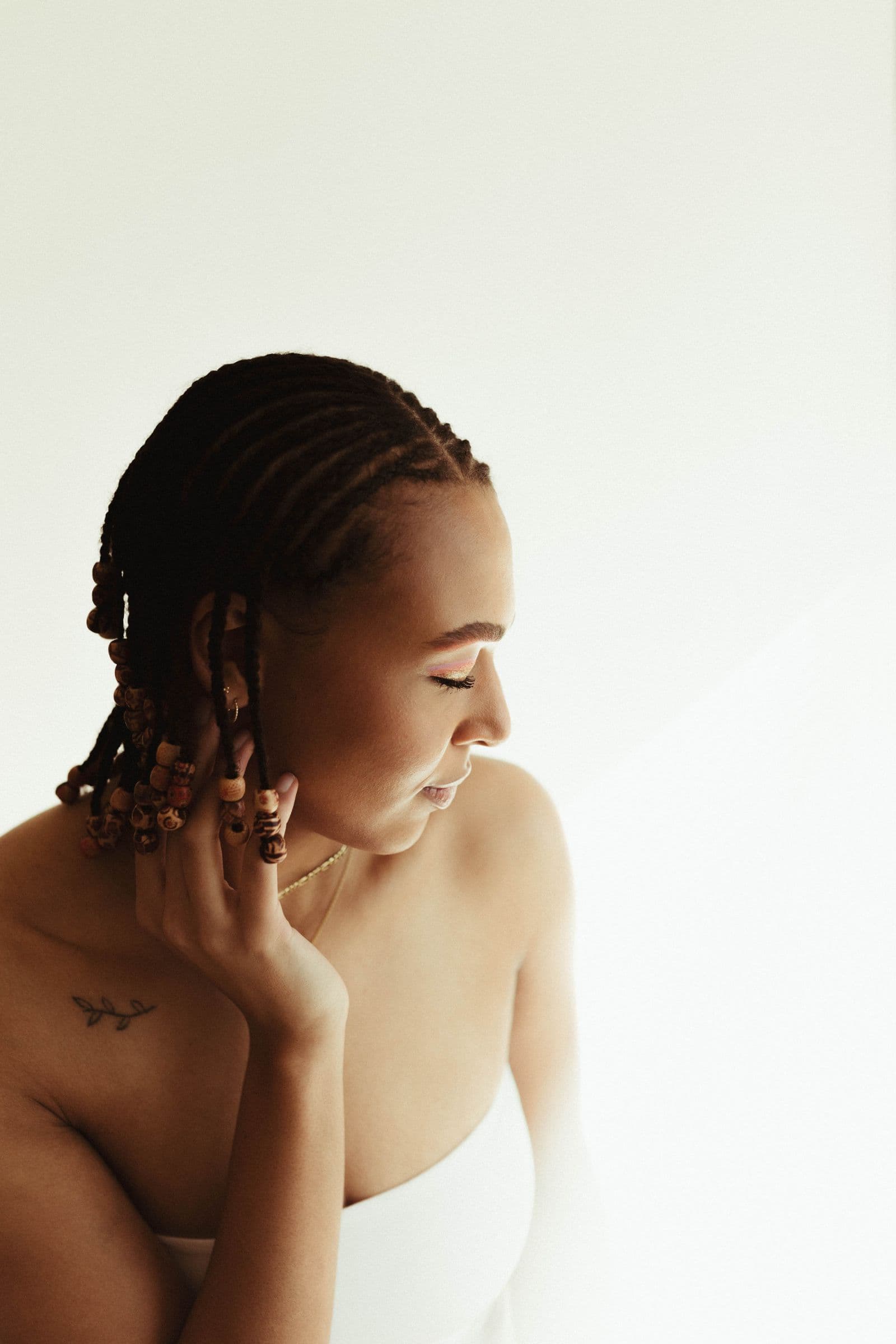
There is a ritual that happens in natural hair communities with a frequency that borders on compulsion: the length check. You stretch a coil from root to tip, watch it extend from, say, your collarbone to somewhere near your mid-back, and for a moment you feel the satisfaction of knowing your hair is growing. Then you release it. It springs back to somewhere just below your ear. And the moment collapses.
This is the most common source of anxiety for women with Type 4 hair. Not the actual length. The visible difference between what the hair is and what it appears to be.
Shrinkage — the coiling of the hair shaft back toward the scalp when moisture is present — can reduce 4C hair to 25% of its stretched length. Sometimes less. A woman whose hair reaches her shoulder blades when stretched may appear to have hair that barely passes her chin in its natural, hydrated state.
The emotional response to this is well-documented in natural hair communities: frustration, discouragement, the persistent feeling that the hair is not growing. What is less well-documented is what shrinkage is actually telling you about your hair's health.
Texture
The Type 4 family
4A
Springy coils
Tight, springy S-shaped coils with a visible curl pattern. Holds moisture best of the three.
Shrinkage ~30%
4B
Sharp Z-bends
Bends in sharp angles rather than curling. Densely packed, fluffy, less defined.
Shrinkage ~50%
4C
Tightest coil
The tightest pattern, often with no defined curl until defined. Maximum volume — and maximum shrinkage.
Shrinkage up to 75%
Shrinkage is not lost length — it is the coil doing exactly what it should. The tighter the pattern, the more it springs back. We measure length stretched, and celebrate the spring.
The Biology of the Coil
Hair shrinkage is not a defect. It is the mechanical consequence of the hair shaft returning to its resting geometry.
The cross-sectional shape of a Type 4 hair fibre is highly elliptical — almost flat in some 4C strands, compared to the round cross-section of straighter hair types. This flatness means the fibre has a natural bias: it is more flexible in one plane than another, and it coils in the direction of least resistance. When the strand is hydrated, the cortex swells asymmetrically — more on one side than the other due to the uneven distribution of the cortical cells — and this asymmetry reinforces the curl, pulling the strand back into its coiled geometry.
The tighter the coil and the more uniformly the hair is hydrated, the more dramatically it shrinks. Which means: maximum shrinkage = maximum hydration = healthy, intact cuticle doing its job correctly.

What Shrinkage Absence Actually Signals
When natural hair does not shrink, it is not a positive sign. It means one or more of the following:
The hair is dry. An insufficiently hydrated strand does not have the cortex water uptake to drive the asymmetric swelling that creates curl. Dry 4C hair may appear to have more length because it is not coiling back on itself — but this is not growth. It is dehydration.
The hair is damaged. Heat damage is the most common culprit. Repeated high-heat application — above approximately 230°C without adequate heat protection — permanently alters the protein structure of the cortex, disrupting the asymmetric cell distribution responsible for curl formation. Heat-damaged hair does not coil because the mechanism for coiling has been chemically and structurally destroyed. The length visible is real, but the hair producing it is compromised.
Product buildup is weighing the curl down. Heavy products applied repeatedly without a clarifying wash can coat the shaft sufficiently to suppress the curl's natural spring. This is reversible — a clarifying wash and chelation if mineral buildup is also present will restore the curl. But it reads, until addressed, as reduced shrinkage and thus "more length."
“In each of these cases, the "more length" is a symptom of something wrong. Hair that shrinks properly is hair that is hydrated, intact, and functioning as designed.”

The Cultural Context of Shrinkage Stigma
The discomfort many women feel about shrinkage does not originate from them. It was installed.
In the context of European beauty standards being enforced as universal through colonialism and its cultural aftermath, the characteristics of Type 4 hair — tight coil, shrinkage, volume rather than length — were coded as "unruly," "unprofessional," and requiring correction. The value assigned to long, straight, hanging hair was not aesthetic neutrality. It was a political valuation in which Black hair was compared to a standard it was never designed to meet and found lacking.
The relaxer was, among other things, a technology for eliminating shrinkage: making Type 4 hair behave like Type 1. That this was sold as "manageability" obscures what was actually being managed — the legibility of Blackness in white professional and social spaces.
Reclaiming shrinkage is therefore not simply a personal hair care choice. It is a refusal of that framing. The shrinkage is not a failure to be a different kind of hair. It is the expression of what your hair actually is.
Texture
The Type 4 family
4A
Springy coils
Tight, springy S-shaped coils with a visible curl pattern. Holds moisture best of the three.
Shrinkage ~30%
4B
Sharp Z-bends
Bends in sharp angles rather than curling. Densely packed, fluffy, less defined.
Shrinkage ~50%
4C
Tightest coil
The tightest pattern, often with no defined curl until defined. Maximum volume — and maximum shrinkage.
Shrinkage up to 75%
Shrinkage is not lost length — it is the coil doing exactly what it should. The tighter the pattern, the more it springs back. We measure length stretched, and celebrate the spring.
Measuring Length Retention Correctly
If you want to track your hair's growth, measure it stretched, not natural. This is not vanity — it is accuracy. The stretched length is the true length of the strand. The natural coiled length is a display choice, not a growth metric.
The method: separate the hair into consistent sections (usually four), and gently stretch each section along a ruler or measuring tape from root to tip while holding a marker point at the same reference (usually the nape, the crown, or a specific ear point). Photograph with the tape visible. Measure again in 8 weeks.
You will find that 4C hair, grown with consistent care, retains approximately 1–1.25cm per month. Over a year, that is 12–15cm of new growth. Whether any of it is visible in the hair's resting state depends entirely on how well you retain what has grown.
The Ritual Response
When your freshly washed, conditioned hair coils tight and springs back toward your scalp, run your fingers through it. Feel the spring. The elasticity in a healthy coil is unmistakable — there is tension and life in it, a restoring force that pushes back against your fingers. That is your hair in its optimal state: hydrated, intact, structurally sound.
The Sanyu Balm, applied as a sealant after washing, preserves that spring. The oils in the Signature Oil maintain the hydration that creates it. The ritual exists to keep the curl's geometry intact — not to straighten it, not to elongate it, but to honour it as what it is.
Shrinkage is information. It is telling you your hair is alive.