The Knot You Did Not Tie
You are doing your weekly detangle. You separate a section, run your fingers from tip to root, and find it: a tiny, hard knot on a single strand, midway down the hair. You try to work it loose. You cannot. You find another. Then another.
Single-strand knots — SSKs, sometimes called fairy knots — are one of the most common frustrations for women with Type 4 hair. They cause breakage during detangling, split ends when they are cut off, and the persistent, demoralising sense that the hair is working against itself.
It is, in a specific mechanical sense, doing exactly that.
Texture
The Type 4 family
4A
Springy coils
Tight, springy S-shaped coils with a visible curl pattern. Holds moisture best of the three.
Shrinkage ~30%
4B
Sharp Z-bends
Bends in sharp angles rather than curling. Densely packed, fluffy, less defined.
Shrinkage ~50%
4C
Tightest coil
The tightest pattern, often with no defined curl until defined. Maximum volume — and maximum shrinkage.
Shrinkage up to 75%
Shrinkage is not lost length — it is the coil doing exactly what it should. The tighter the pattern, the more it springs back. We measure length stretched, and celebrate the spring.
Why SSKs Form: The Curl Geometry
A single-strand knot forms when a shed hair — one that has released from the follicle and is no longer attached at the root — wraps around a live, growing strand. Because neither strand can release (one is still attached, and the shed strand is now coiled around it), the wrapped strand tightens into a knot as the hair moves, dries, and is manipulated.
Why does this happen more in Type 4 hair than in other curl types?
The tight helix of the Type 4 curl creates a dense coiling pattern with a very short pitch — the distance between each revolution of the spiral. A straight hair has zero coiling. A 3A curl has a wide, loose spiral. A 4C strand coils so tightly that any loose strand moving through the hair's environment is almost geometrically certain to encounter a curl, wrap around it, and tighten.
This is particularly likely at the tips of the hair, where the strand is thinnest and the free end can move most freely. The tapered, finer end of the strand acts as a needle threading itself through the gaps in adjacent curls. A single shed hair that should have fallen away instead gets woven into the living hair above it, forming a knot that neither strand can escape.
The result is not one knot — it is dozens or hundreds, throughout the hair, particularly concentrated toward the tips and in the most tightly coiled sections.
Under the microscope
The cuticle's overlapping scales
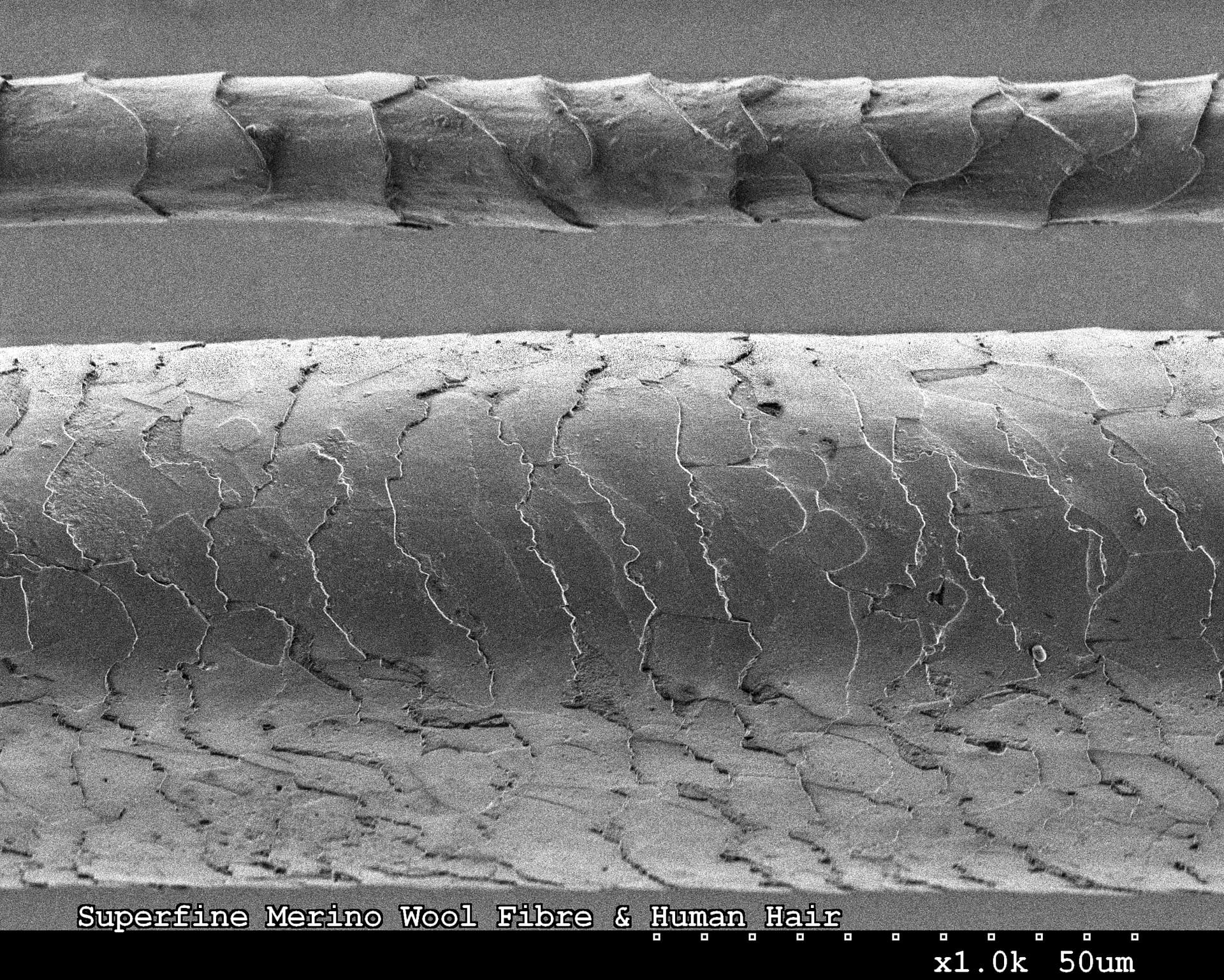
Human hair (below) shares the tiled, overlapping-scale architecture of wool (above). Sealed flat, these scales trap moisture in; lifted, they let it escape.
SEM: CSIRO · CC BY 3.0
The Role of Dryness
Dryness dramatically increases SSK formation. Here is why:
A well-moisturised 4C strand is coated in a film of oil and humectants that allows adjacent strands to slide past each other with minimal friction. The curl can spring and move without individual strands catching on each other. The shed hair that releases from the follicle can travel out of the hair with the normal shedding process.
A dry 4C strand has a rough, raised cuticle — the scale-like cells on the shaft surface are lifted rather than lying flat. When a shed hair with a rough cuticle encounters a coil with its own rough cuticle, the two surfaces catch. The shed hair cannot slide through the coil; it wraps around it instead, and the knot begins.
“This is why SSK formation accelerates dramatically in winter, in dry climates, after periods of product neglect, and in hair that has not been deeply conditioned recently. The dryness is not just uncomfortable — it is mechanically creating the conditions for self-entanglement.”

The Chebe Coating: Why It Helps
One of the primary mechanisms by which chebe reduces SSK formation is by smoothing the shaft surface.
The resinous compounds in chebe (*Croton zambesicus*) bind to the outer cuticle surface and create a semi-smooth coating over the scale texture of the cuticle cells. This coating reduces the coefficient of friction between adjacent strands — the shed hair that would have caught on a rough cuticle can now slide through or past the adjacent curl, releasing naturally rather than wrapping and knotting.
This is the same principle as applying conditioner: conditioner provides temporary cuticle-smoothing through film-forming polymers and fatty alcohols. Chebe provides a more durable version of this effect, lasting through multiple wash days rather than washing out with each wash.
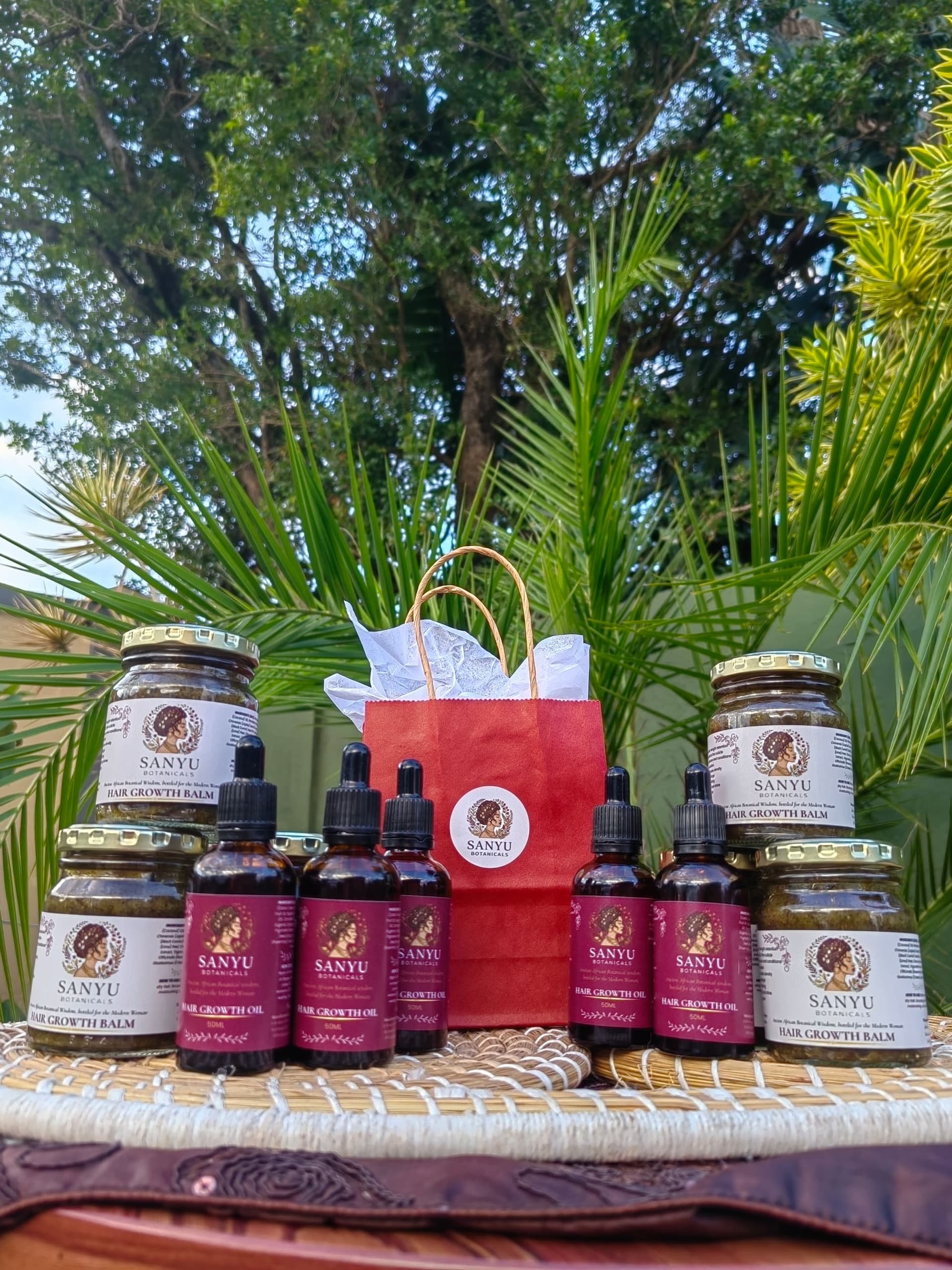
The Sanyu Balm applied as a sealant after each wash day maintains the chebe coating on the shaft surface continuously. The shaft stays smoother, shed hairs encounter less resistance moving through the hair, and the rate of SSK formation decreases measurably over 4–6 weeks of consistent use.
Texture
The Type 4 family
4A
Springy coils
Tight, springy S-shaped coils with a visible curl pattern. Holds moisture best of the three.
Shrinkage ~30%
4B
Sharp Z-bends
Bends in sharp angles rather than curling. Densely packed, fluffy, less defined.
Shrinkage ~50%
4C
Tightest coil
The tightest pattern, often with no defined curl until defined. Maximum volume — and maximum shrinkage.
Shrinkage up to 75%
Shrinkage is not lost length — it is the coil doing exactly what it should. The tighter the pattern, the more it springs back. We measure length stretched, and celebrate the spring.
Stretch Drying: The Second Prevention Mechanism
SSKs form most readily when the hair dries in its maximum coiled state, because this is the geometry in which curls are closest together and shed hairs have the most opportunity to self-entangle.
“Stretch drying — drying the hair in a stretched or semi-stretched state — reduces the coil density during the critical drying period. Methods include:”
African threading
Thread wrapped around sections of hair maintains a gentle stretch without heat or tension. The traditional method, used across West and East Africa, keeps hair elongated as it dries and prevents curl-on-curl contact.
Banding
Small hair bands placed at 2–3 inch intervals down each section stretch the hair without heat.
Loose twists or braids
Two-strand twists do not eliminate coiling but reduce curl-on-curl contact within each twist. Washing in twists and allowing them to dry before unravelling reduces SSK formation significantly compared to washing with hair loose.
The principle: any technique that reduces the density of curl contact during the drying phase reduces the number of opportunities for shed hairs to wrap around live strands.
Under the microscope
A single strand, magnified
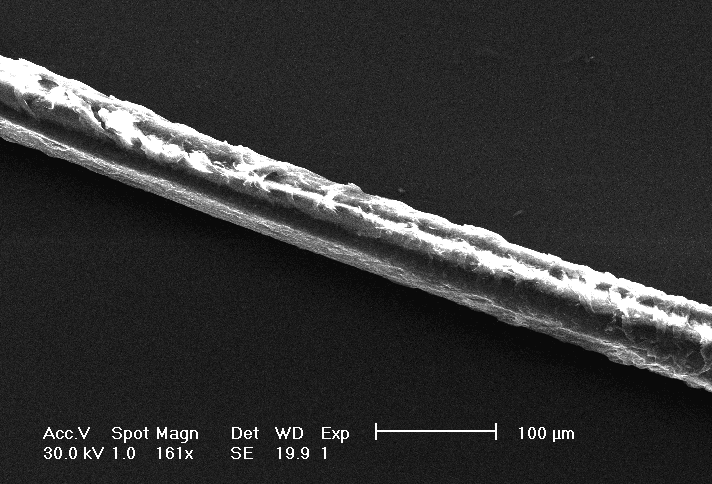
Under the electron microscope a human hair is a rope of keratin sheathed in the cuticle — the strand's outer armour. Oils and butters lie over it, slowing the moisture loss that costs you length.
SEM: Foreade · CC BY-SA 4.0 · Wikimedia Commons
Detangling Method
Once SSKs have formed, detangling technique determines how much damage their presence causes.
Fingers first, always. Begin detangling with your fingers on well-saturated, conditioner-coated hair. Fingers can feel knots before they encounter them with force. A wide-tooth comb cannot. When a fine-tooth comb or dense paddle brush hits an SSK, it pulls — either tearing the knot through the strand (causing a break or split) or pulling out the surrounding hair.
Work in sections. Divide the hair into 6–8 sections for detangling. This keeps the hair manageable, prevents previously detangled sections from re-tangling, and allows you to apply fresh conditioner or slip product to each section as you go.
Start at the tip, work toward the root. Beginning at the root and pulling downward forces tangles and knots toward the end of the strand, compressing them and making them tighter. Starting at the tip and working upward in small increments releases tangles without compressing them.
Apply the Signature Oil for slip during dry detangling. For hair that has been in a protective style or twist-out, apply 2–3 drops of Signature Oil to each section before detangling. The oil reduces friction between strands as the fingers work through them, and the slip provided by the castor and olive components allows shed hairs to release rather than pulling live hairs with them.
Trimming vs. Cutting SSKs
The correct response to a single-strand knot you cannot work loose is to cut it, not pull it.
The knot sits on the strand as a hard, immovable node. Below the knot, toward the tip, the strand is still structurally intact but is now permanently compromised — the knotted portion will catch on everything it encounters and eventually break there anyway. Cutting just above the knot removes the compromised section cleanly.
“Do not pull. Pulling a tight SSK exerts force across the entire length of the strand below it, and the strand's weakest point — whether the knot itself or a point of previous damage nearby — will fail.”
Trimming the ends every 10–12 weeks removes the section where SSK density is highest (the tips, where the strand is thinnest and has been exposed to the most friction and manipulation). This is not contradictory to length retention — it is the means of it. Trimmed, clean ends are less likely to tangle, less likely to knot, and less likely to split and travel up the shaft. The hair you trim would have broken off within weeks anyway. You are simply controlling where and how the removal happens.
Texture
The Type 4 family
4A
Springy coils
Tight, springy S-shaped coils with a visible curl pattern. Holds moisture best of the three.
Shrinkage ~30%
4B
Sharp Z-bends
Bends in sharp angles rather than curling. Densely packed, fluffy, less defined.
Shrinkage ~50%
4C
Tightest coil
The tightest pattern, often with no defined curl until defined. Maximum volume — and maximum shrinkage.
Shrinkage up to 75%
Shrinkage is not lost length — it is the coil doing exactly what it should. The tighter the pattern, the more it springs back. We measure length stretched, and celebrate the spring.
The Prevention Summary
Keep the hair moisturised. Apply the balm consistently for its shaft-smoothing chebe action. Stretch-dry when possible. Detangle in sections with slip. Trim regularly. Sleep in a satin bonnet.
None of these steps is dramatic. All of them are cumulative. SSKs are not a crisis — they are a maintenance problem. Address them as such, with patience and consistency, and your detangling sessions will get progressively easier as the shaft surface stays smoother and the dryness that enables self-entanglement is addressed at source.