The Head Spoke First
In much of pre-colonial Africa, you could learn a great deal about a stranger before they opened their mouth — simply by reading their hair. Marital status, age group, ethnic nation, wealth, spiritual office, whether the person was in mourning or preparing for marriage: all of it could be carried in the shape of the crown.
This was not decoration. It was a functioning social language, as precise in its own way as a uniform or a wedding ring. To understand African hair is to understand that for most of human history on this continent, the head was a place where the most important facts about a life were written for everyone to read.
Here are a few of its dialects.
Hibiscus — colour worn like a crown.
Amasunzu — Rwanda
Among the Rwandan people, the *amasunzu* was a sculpted hairstyle of remarkable geometry — the hair shaped into crescents and ridges that rose from the head like carved relief. It was worn by young unmarried women and by men of standing, particularly warriors. For a young woman, the amasunzu signalled that she had come of age and was not yet married; on a man, it spoke of courage and status.
It is a precise example of hair as a public statement of exactly where a person stood in the order of their society — visible across a field, requiring no introduction.
The Isicholo — amaZulu
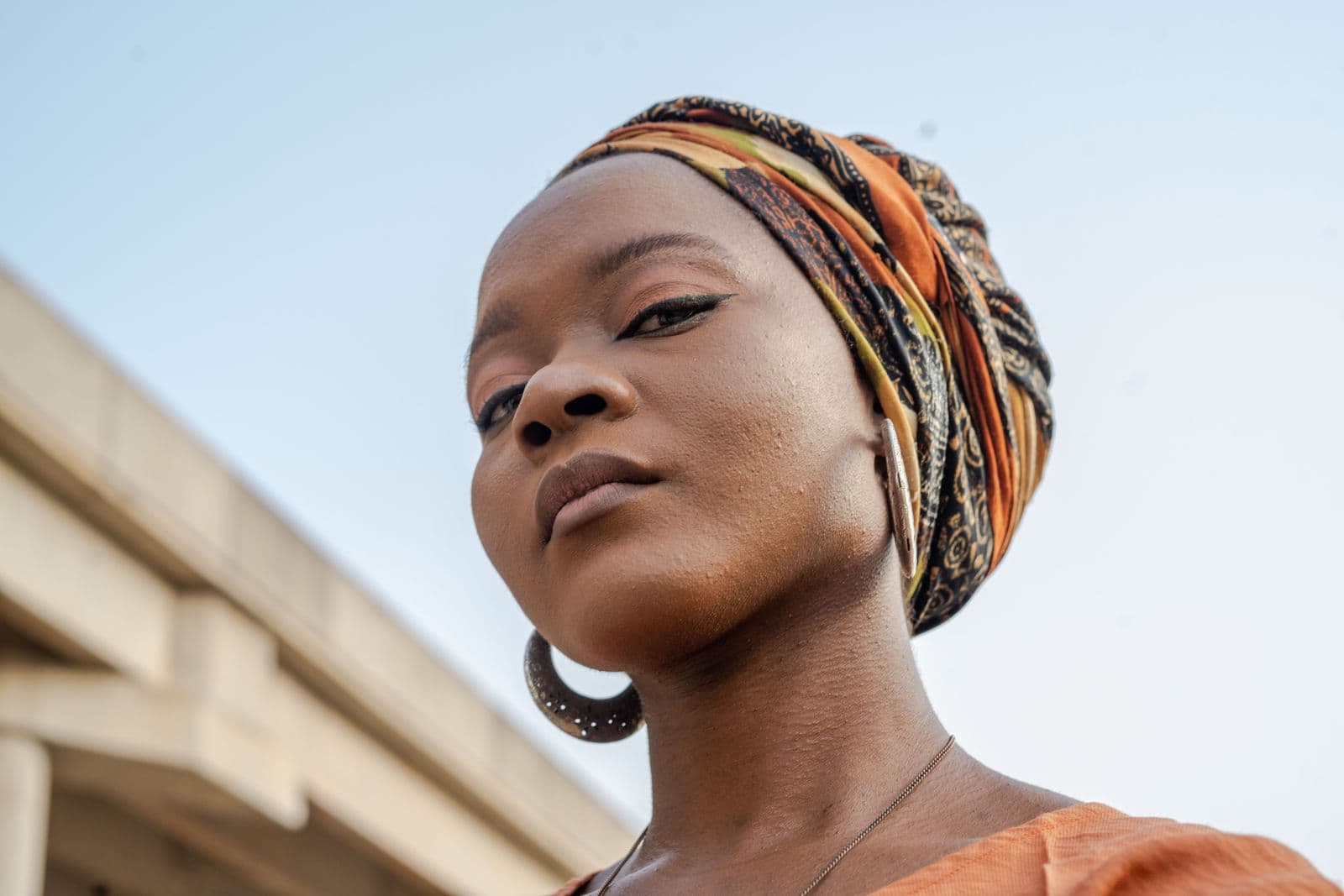
Among the amaZulu, the *isicholo* is the headdress and hairstyle of a married woman. Historically the hair itself was built up and shaped into a wide, flared form, often reddened with ochre, and worn high. The flare announced a married woman's status with unmistakable dignity. To wear it was to wear a fact: this woman is married, and she is to be addressed accordingly.
The isicholo survives today most visibly as a structured hat in traditional dress — but its root is the hair, sculpted into a sign of standing and respect.
The Fulani Braids — the Sahel
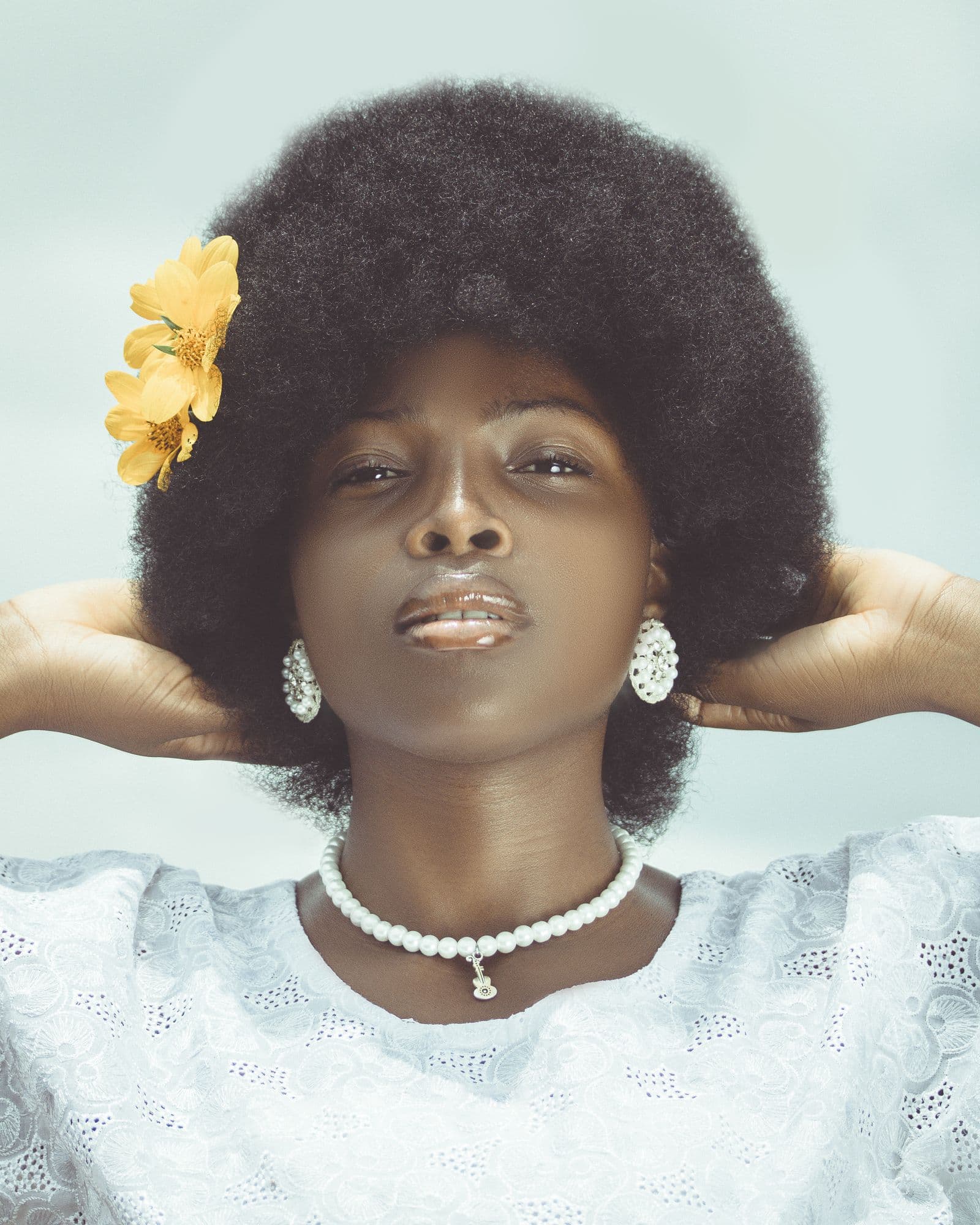
The Fulani, the great cattle-herding people stretched across the Sahel from Senegal to Sudan, are known for braids worked through with silver coins, amber, and cowrie shells. The cowrie was currency across much of Africa for centuries; to braid wealth into the hair was to wear a family's history and means in plain sight.
Fulani styling often features a central plait running front to back with braids falling at the sides, the hairline adorned with inherited beads and metal passed down through generations. The hair became an archive of lineage — heirlooms worn, not stored.
Hibiscus — colour worn like a crown.
The Mangbetu — north-east Congo
The Mangbetu people created one of the most striking silhouettes in African hairstyling: hair drawn up and out over a woven frame into a flared halo, a crown that widened above the head. It was a mark of beauty and aristocratic refinement, associated with a people known for sculpture and craft, and it turned the head itself into a work of art.
Otjize and the Himba — Namibia
Among the Himba of north-western Namibia, hair is one of the clearest texts of a person's life stage. Children's hair is braided in ways that signal their age. A girl approaching marriageable age, a newly married woman, a mother — each is marked by a distinct arrangement of braids and headpieces. Married women wear the *erembe*, a headdress of treated skin, atop hair dressed with *otjize*: a paste of butterfat and red ochre that gives Himba hair and skin its deep, luminous red.
The otjize is striking for another reason — it is a beauty practice built for a place with very little water. Rather than washing the hair daily, Himba women dress it with the ochre-and-fat paste, which conditions, colours, protects against the sun, and is renewed rather than rinsed. It is a complete cosmetic system adapted to the desert, and it is centuries old.
Hair and the Spirit
For the Yoruba of what is now Nigeria, the head — *ori* — is more than the top of the body. It is the seat of a person's destiny and spirit, the most sacred part of the self. To touch someone's head carelessly was a serious matter; to dress it was an act of care toward the soul as much as the body.
This belief, in many forms, recurs across the continent: the head is high, the head is sacred, the hair that grows from it is close to the spirit. When elders said that what grows from the crown should be treated with reverence, they were not being sentimental. They were stating a cosmology.
It is also why the colonial and missionary campaigns against African hair cut so deep. To be told that your hair was unkempt, heathen, or in need of correction was not only an insult to appearance. In the logic of the cultures being targeted, it was an attack on the spirit's own seat — on the most sacred thing a person carried.
Hibiscus — colour worn like a crown.
Reading It Again
Much of this language has been interrupted. Colonialism, mission schooling, and the long pressure of European beauty standards taught generations to read their own crowns as problems to be solved rather than statements to be made.
But the grammar was never fully lost. It survives every time a woman chooses a style with intention — for a wedding, a funeral, a homecoming, a new chapter. It survives in the care taken over a child's first proper hairstyle. It survives in the simple, defiant decision to wear the hair that grows from your own head, shaped the way you choose, in public, without apology.
“The crown still speaks. We make our oils and balm to keep it strong enough to say whatever you want it to.”