The Water Problem Nobody Mentions
You have tried every product. You have adjusted your routine. You deep condition faithfully. And still your hair feels rough, straw-like, product-resistant — like nothing is penetrating, like you are applying oils to a sealed surface.
If you live in Johannesburg, Pretoria, the Vaal region, or parts of the Western Cape, there is a reasonable chance your tap water is the problem nobody told you about.
Porosity
How thirsty is your hair?
Low porosity
Cuticles lie tight and flat. Water beads and rolls off; products sit on top. Needs warmth and humectants to let moisture in.
Medium porosity
Cuticles sit slightly open. Accepts and holds moisture well — the easiest balance to keep.
High porosity
Cuticles lift and gap — often from heat, colour, or genetics. Drinks moisture fast and loses it just as fast. Loves a sealing oil and protein.
Porosity is how easily the cuticle lets water in and out. The float test tells you yours — and it decides whether your hair needs more moisture, more sealing, or more protein.
What Is Hard Water?
Water hardness is determined by the concentration of dissolved minerals — predominantly calcium and magnesium — in the supply. Soft water has low mineral content. Hard water has high mineral content, typically expressed in milligrams per litre (mg/L) of calcium carbonate equivalent, or in German degrees of hardness (°dH).
In South Africa, water hardness varies significantly by region. Johannesburg and the Gauteng plateau draw from the Vaal Dam system and the Eastern Highveld aquifers. The underlying geology — dolomite and limestone formations — dissolves readily, leaching calcium and magnesium into the water supply. Many Johannesburg areas register water hardness above 200 mg/L CaCO₃ — a level classified as "hard" to "very hard" by international standards.
Pretoria's supply has historically been even harder in certain zones. Parts of the Western Cape draw from sources with varying hardness depending on proximity to mountain catchments (softer) versus valley aquifers (harder). The Eastern Cape — including East London — generally has softer water from the Orange-Fish system and coastal catchment areas, though this varies by municipality and season.
“The South African Bureau of Standards (SABS) and the Department of Water and Sanitation publish water quality data by supply zone. If you are uncertain about your water hardness, your municipality can provide the current figures.”
What Hard Water Does to the Hair Shaft
When hard water dries on the hair, the minerals remain behind as deposits on the shaft surface. This is the same mechanism as the white limescale that forms around taps and in kettles — the water evaporates, the dissolved minerals precipitate out as crystalline deposits.
On the hair shaft, calcium and magnesium deposits:
1. Form a mineral film that blocks oil absorption. The film sits on top of the cuticle, preventing oils and conditioning agents from penetrating the shaft. This is why hard water hair often feels like products sit on top of it rather than absorbing — they literally cannot get through the mineral coating.
2. Raise and roughen the cuticle. Calcium ions carry a positive charge. The hair shaft surface carries a negative charge. Calcium ions bond electrostatically to the cuticle surface, lifting the cuticle scales and increasing surface roughness. This creates tangles, reduces shine, and makes the hair feel brittle.
3. Reduce elasticity. Research published in the *International Journal of Dermatology* (2016) compared hair samples washed with hard versus soft water over 30 cycles. Samples exposed to hard water showed significantly reduced tensile strength and increased surface roughness under electron microscopy.
4. Create dryness that products cannot correct. If your hair is genuinely depleted of moisture, adding oil helps. But if your hair feels dry because a mineral coating is blocking moisture from entering in the first place, adding more oil on top of the coating only adds to the problem. The mineral film must be removed first.
Under the microscope
Closer still
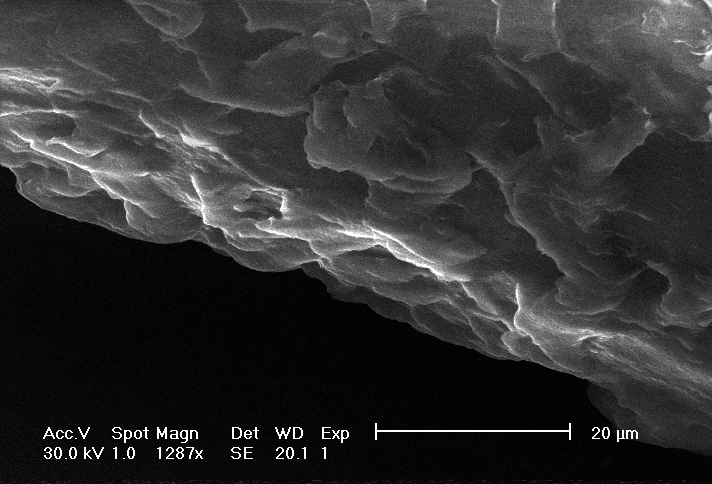
At higher magnification the cuticle's rough, tiled surface emerges. It lies smooth when the hair is moisturised and sealed, and lifts when it is dry or damaged — which is when breakage begins.
SEM: Foreade · CC BY-SA 4.0 · Wikimedia Commons
The South African Context
For Gauteng-based women especially, the combined effect of hard water and the dry Highveld climate creates a compounding problem: minerals deposit on the shaft (blocking moisture), and low ambient humidity then pulls whatever moisture is in the shaft outward through raised cuticle gaps. The hair is being attacked from both directions simultaneously.
This is not a product formulation problem. It is a water infrastructure problem interacting with climate. Understanding it means you can address it directly rather than chasing an endless rotation of products that are not working because the foundational obstacle — the mineral film — has not been dealt with.
Porosity
How thirsty is your hair?
Low porosity
Cuticles lie tight and flat. Water beads and rolls off; products sit on top. Needs warmth and humectants to let moisture in.
Medium porosity
Cuticles sit slightly open. Accepts and holds moisture well — the easiest balance to keep.
High porosity
Cuticles lift and gap — often from heat, colour, or genetics. Drinks moisture fast and loses it just as fast. Loves a sealing oil and protein.
Porosity is how easily the cuticle lets water in and out. The float test tells you yours — and it decides whether your hair needs more moisture, more sealing, or more protein.
Solutions
Chelating shampoo
Chelating (or clarifying) shampoos contain ingredients — typically EDTA (ethylenediaminetetraacetic acid) or citric acid derivatives — that bind to mineral ions and remove them from the hair shaft. A chelating wash once or twice a month dissolves the calcium and magnesium deposits that regular shampoo cannot remove. Do not use chelating shampoo every wash day; it is potent and will strip the shaft if overused. Follow immediately with a deep conditioning treatment.
Apple cider vinegar rinse
A diluted ACV rinse (1 part apple cider vinegar to 10 parts water) lowers the pH of the hair surface. Calcium carbonate is alkali-soluble; an acidic rinse dissolves surface deposits and helps close the cuticle. Apply after the final rinse, allow 2–3 minutes, then rinse with cool water. Do not use undiluted ACV — it is acidic enough at full strength to cause irritation and protein degradation with repeated use.
Filtered final rinse
Keep a jug or spray bottle of filtered or boiled-and-cooled water near your shower. After your final shampoo and conditioning rinse, do a last pass with the filtered water. Filtered water has significantly reduced mineral content, meaning you are finishing your wash without depositing a new layer of calcium and magnesium onto your freshly cleaned shaft.
The Sanyu Signature Oil and mineral deposits
Oleic acid — the primary fatty acid in olive oil and a significant component of the Signature Oil blend — is emollient enough to penetrate between mineral deposits on the cuticle surface and provide limited conditioning even through a mineral film. This is why the Signature Oil provides some relief even in hard water conditions. However, it is not a substitute for a monthly chelating wash. Use both: chelate monthly to remove the film, then apply the oil to the clean, deposit-free shaft for maximum absorption.
Shower head filter
A KDF or activated carbon shower head filter removes a significant proportion of dissolved calcium and magnesium from the water as it exits. These are available at plumbing retailers and online in South Africa for R300–R800. For women in high-hardness areas, this is the most efficient long-term solution — it addresses the problem at source rather than requiring a correction step after every wash.
How to Know If Hard Water Is Your Problem
Take a strand of hair and feel it between your fingers after it air-dries post-wash. If it feels rough, stiff, and has little movement, run it through a chelating wash, follow with a 20-minute deep conditioner, and feel it again.
If the strand is noticeably softer, more pliable, and has better slip, you have just confirmed your diagnosis. You do not have difficult hair. You have been working against your water.